
On November 17, 2026, the U.S. Department of Labor (DOL) published a proposed rule that would overhaul PERM (Program Electronic Review Management) labor certification, the first step in most employer-sponsored green cards. The changes are big. Recruitment would run at least 90 days, employers with recent layoffs could be barred from filing, and the Schedule A shortcut for nurses, physical therapists, and people of exceptional ability would go away.
Under the proposal, PERM would take longer, cost more, and be harder to file. That makes it worth knowing which employees may not need PERM at all.
The proposed rule itself points to the answer. A few green card categories don’t require PERM.
What the proposed rule would change.
The proposal touches almost every part of PERM. The changes that matter most for planning are these.
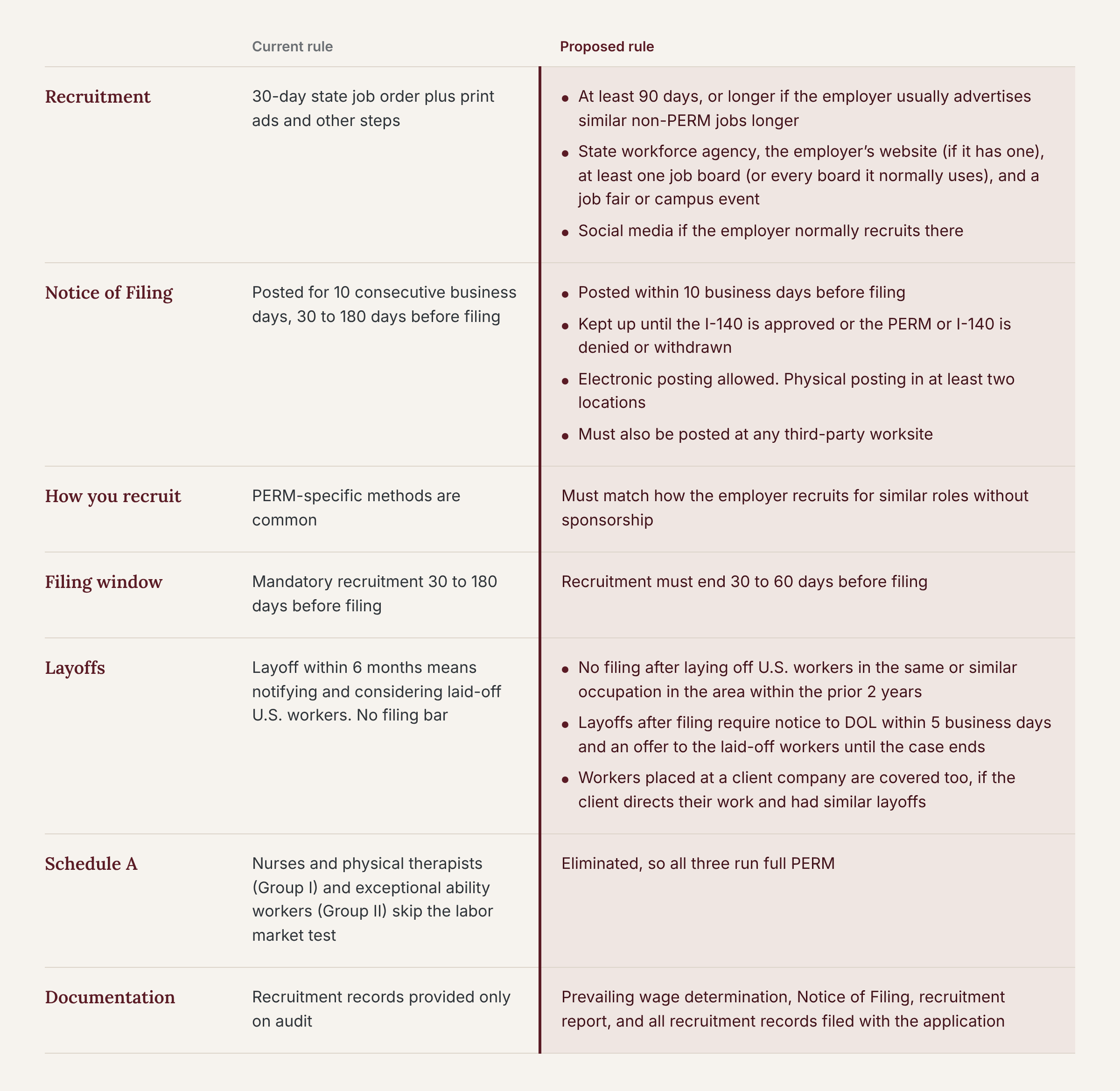 The recruitment rules above apply to most PERM cases. College and university teachers, professional athletes, and professional sports team coaches have a separate, optional recruitment process under the proposal.
None of this is in effect yet. It’s a proposal, and employers should keep following the current rules.
The green card routes that don’t run through PERM.
In its discussion of the statutory framework on page 73917 of the proposed rule, DOL spells out that the immigration statute gives one exception to labor certification for EB-2 and EB-3 cases, the national interest waiver (NIW). Every other EB-2 and EB-3 case needs PERM. The EB-1 categories never required labor certification in the first place.
So for the workers employers would normally sponsor through PERM, there are four paths that skip it entirely.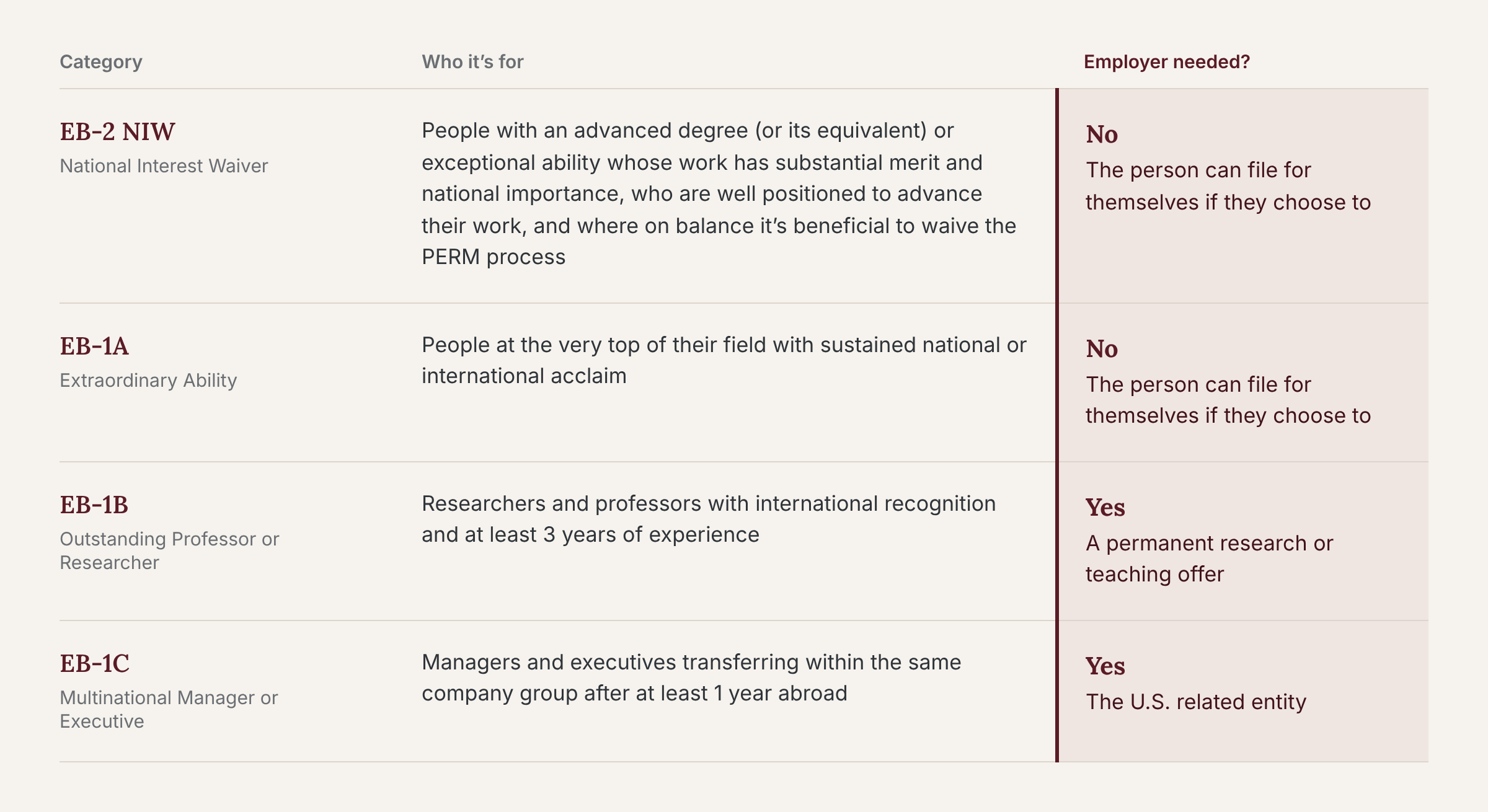
To learn more about each category, see my pages on EB-2 NIW, EB-1A, EB-1B, and EB-1C.
None of these involve recruitment, prevailing wage determinations, or the new layoff rules. The case goes straight to U.S. Citizenship and Immigration Services (USCIS) through a Form I-140 Immigrant Petition filing.
That’s the difference that matters. Under the proposal, PERM would add at least 90 days of recruitment, plus the waiting period after, before the case can even be filed with DOL. These four (4) categories skip that whole stage.
Who should take a closer look.
Three groups are hit hardest by the proposal, and they’re also the groups most likely to qualify for a route that skips PERM.
Employers that have had layoffs. This is the biggest one. Under the proposal, if you laid off U.S. workers in the same or similar occupation in the area within the past 2 years, you can’t file PERM for that role at all. For a lot of tech companies, that could take PERM off the table for some roles. Layoffs after filing would also trigger notice, rehiring, and recruitment report duties that last until the I-140 is approved or the case is denied or withdrawn. Employers that place workers at client sites would also need to watch for layoffs at the client.
EB-1B, EB-1C, and NIW cases don’t go through DOL, so the layoff bar doesn’t apply to them. EB-1B and EB-1C are still employer-sponsored, which means you can keep supporting your key people’s green cards.
People of exceptional ability in the sciences or arts. Right now, Schedule A Group II lets employers skip the labor market test for these workers. DOL proposes eliminating it, and says it would do so even if it found a way to update Schedule A. For scientists and artists, Group II already requires evidence of widespread acclaim and international recognition, much of the same evidence used for EB-1A, EB-1B, and NIW cases. If you were planning a Group II filing, it’s worth checking whether one of those fits instead.
Universities and research institutions. Today, universities can file a professor’s PERM up to 18 months after selecting the candidate through a competitive search (PERM Special Handling). The proposal would cut that to the same 30-day window everyone else gets. DOL is asking in the proposed rule on page 73938 for comment on how that would work for faculty searches. The EB-1B I-140 Immigrant Petition process for outstanding professors and researchers starts to look a lot better, since it skips recruitment entirely, if an individual is potentially qualified.
This isn’t for everyone.
These categories aren’t a workaround, and most employees won’t qualify for them. A few things to keep in mind.
- The evidence bar is high. EB-1A requires sustained international or national acclaim at the very top of the field. NIW and EB-1B require a real track record, usually publications, citations, awards, or other recognition. A thin case is typically a denied case.
- They don’t fix backlogs. NIW is still an EB-2 category, so it waits in the same EB-2 line as an EB-2 PERM case. EB-1 also has long waits for some countries, including India and China. It’s always best to check the current Visa Bulletin for the employee’s country of birth before assuming any route is faster.
- It doesn’t have to be one or the other. An employer can run PERM while the employee files an NIW or EB-1A on the side. If one is approved, the employee has a path forward either way.
The point isn’t to skip PERM whenever you can. It’s to look at every option before you commit to a 90-day recruitment you might not need.
Timeline and what to do now.
Comments on the proposal are due January 19, 2027. After that, DOL has to review the comments before it can publish a final rule, which could look different from the proposal. DOL is proposing a 90-day transition once a final rule publishes, made up of a 60-day delayed effective date plus another 30 days. Cases filed before the cutoff would be processed under the current rules. For a refresher on how federal rulemaking works, see my earlier article here.
For employers, there’s no reason to wait to start planning.
- Look at your PERM pipeline. If a case is already planned, it may make sense to start recruitment sooner so it can be filed under the current rules.
- Check your layoff history. If you’ve had layoffs in the past 2 years, figure out which roles could be affected under the proposed bar.
- Screen your sponsored employees for EB-1 and NIW. Researchers, senior engineers, executives transferred from abroad, and anyone with a strong publication or award record are good places to start.
- Consider commenting. If the proposal would affect how you hire, DOL is taking comments through January 19, 2027.
Which path fits depends on the employee’s background, the role, and the employer’s layoff history. Those facts are worth reviewing before starting a new PERM case.