
Update: October 22, 2026
The November bulletin is out, and USCIS is again using Chart B.
The November 2026 Visa Bulletin has been published, and USCIS has confirmed that both employment-based and family-based applicants can use the Dates for Filing chart (Chart B) for November, the same chart it honored in October.
Under Chart B, employment-based applicants can file Form I-485 with priority dates before:
- EB-2 Rest of World: March 15, 2026
- EB-3 Rest of World: August 1, 2024
- EB-2 and EB-3 India: January 15, 2015
- EB-1 India and China: July 1, 2024
- Other Workers Rest of World: July 1, 2022 (up one month from October)
On the Final Action Dates chart, movement was modest and mostly forward. EB-2 Rest of World recovered about three months, advancing from January 1, 2025 to April 1, 2025 and partly undoing October's retrogression. EB-3 Rest of World advanced to June 15, 2024, Other Workers Rest of World to June 1, 2022, and EB-1 China to August 1, 2023, while EB-1 Rest of World stayed current. India saw little relief, with EB-2 holding at November 1, 2013 and EB-3 advancing only to January 22, 2014.
If your priority date falls within Chart B, a filing window is open for you now. Chart selections and cut-off dates can change month to month, so it is generally better to file in November than to wait.
What exactly is the Visa Bulletin? A plain-English guide to the green card line, a look at what November may bring, and the real options available to people stuck in a backlog.
When most people consider pursuing lawful permanent resident status (green card), they tend to ask "how long will it take," or "how long is the line I am in?" So what exactly is this line? That is where the Visa Bulletin most often comes into play, especially for people pursuing a green card through an employment-based category. The bulletin also applies to people pursuing a green card through family sponsorship (a spouse, siblings, children, and so on). For purposes of this article, though, I will focus on the employment side of things.
If you are already waiting on a green card through a backlogged visa category, the Visa Bulletin, which is released every month for the following month by the U.S. Department of State, can feel a lot like running a marathon, not a sprint. It helps to understand what the bulletin is, what the next edition may show, and, most importantly, what you can do while you wait. This article gives a high level overview of the Visa Bulletin, a projected outlook of the November 2026 Visa Bulletin, and a practical rundown of the options a backlogged applicant can explore.
 What is this Visa Bulletin, and why is it important?
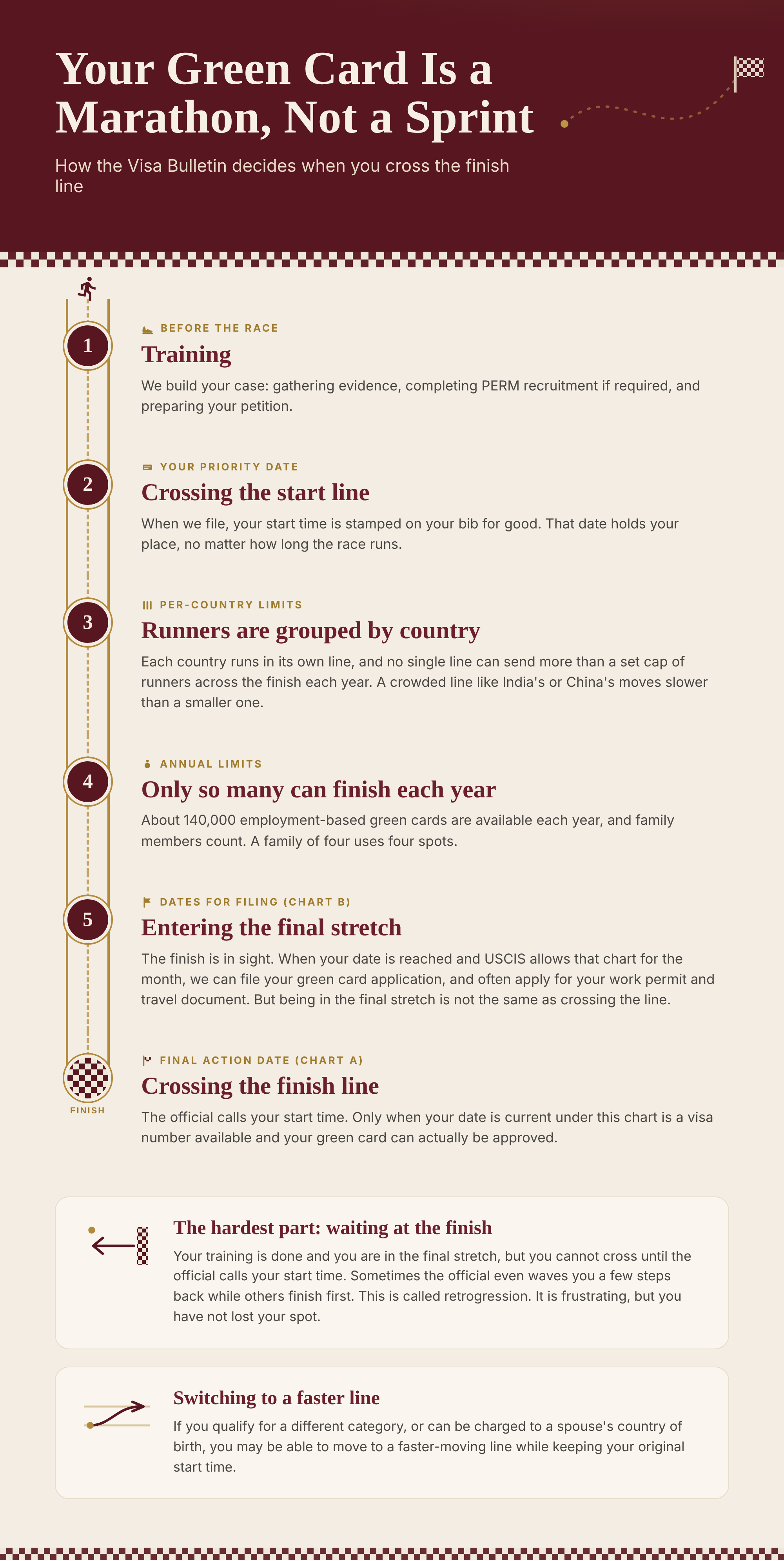
Think of it as a marathon. All the work done up front is your training. When the application or petition is filed, you cross the start line, and that time gets marked on your bib for good. That stamped time is your priority date, your place in the race to the green card. The catch is that in the employment-based race only about 140,000 runners are allowed to finish the race each year, and that number even includes the runners' spouses and dependent children. Runners are also grouped by country of birth into separate starting corrals, each country's own line, and no single corral can send more than a set cap of runners across the finish each year, no matter how many are packed into it. To further this analogy, the Visa Bulletin is like the race official on the course calling out, each month, which bib times (priority dates) are allowed to come through. If you are from a country with a lot of runners, like India or China, your corral moves slower, not because you are slower, but because that cap limits how many from your corral can finish each year while the runners keep lining up behind you.
With this analogy in mind, here is the mechanism behind it. For many green card categories, more people want visas than the law makes available each year, so a line forms. Your place in that line is your priority date, which is usually the date your underlying petition (I-140 Immigrant Petition) or labor certification (ETA-9089) was filed. Each month the Department of State publishes the Visa Bulletin, which lists cut-off dates by category and by country of chargeability. If your priority date is earlier than the relevant cut-off, you have reached the step that chart governs, which is either being allowed to file or being eligible for final approval, depending on the chart. If it is not, you wait.
One distinction worth mentioning, and one I see missed all the time, is the difference between the two charts on the Visa Bulletin, and the marathon analogy makes it easy to understand. Final Action Dates (Chart A) are the actual finish line. They control when a case can really be approved and the green card issued, the moment you cross and get the medal, and a visa number, the thing that actually allows the green card to be approved, is only available under this chart. Dates for Filing (Chart B) are generally earlier, and they are more like the official waving you into the final stretch ahead of time. When USCIS is letting people file under Chart B for your category that month (it decides this each month, and can decide differently for family-based and employment-based runners), you can get your application in, and USCIS can go ahead and process the ancillary applications that come with it, such as the work permit (EAD) and advance parole for travel. But getting within sight of the finish line is not the same as crossing it. Your green card still cannot be approved until a visa number is available for you under the Final Action Dates, so filing under the Dates for Filing chart does not mean approval is coming right behind it.
The November 2026 Visa Bulletin outlook.
As of the date of this article, the "race official" has not called out the November starting bib times yet. The November 2026 Visa Bulletin has not been released yet. The Department of State still shows October 2026 as the current bulletin and lists the next one as "coming soon." When the bulletin is released for November, which recently seems like it is coming out later and later in the month, USCIS will then indicate shortly after the release whether it will allow those with a bib number running the race into the home stretch early (file under Chart B), or finish out the race (file under Chart A). Either way, the dates that count are the ones on the official bulletin and the accompanying USCIS determination of which chart applicants may use.
With that in mind, what can you reasonably expect for November's bulletin? Early in the fiscal year, which just started on October 1, a new batch of about 140,000 runners (employment-based visas, including family members) can cross the finish line over the course of the year, until the next October 1, when a fresh set of about 140,000 becomes available. The runners cannot finish all at once, because that would overwhelm the finish line, so the official, through the Visa Bulletin, meters, or slows, the flow of runners across the finish throughout the government's fiscal year. Movement is often modest at this point, and it rarely goes in a single direction across all categories and countries. October brought a fresh annual allotment of numbers and some forward movement, but it also brought retrogression in the worldwide EB-2 and EB-3 categories as issuances were kept within the year's limits. With that landscape in mind, forecasters expect only small forward movement in most employment-based categories in November, likely weeks rather than months, with little near-term relief for the heavily backlogged India EB-2 and EB-3 lines, and the usual country-by-country variation. But dates can hold or move backward just as easily when the supply is being rationed. The best stance to take is to watch for the official bulletin and know your priority date, your employment-based category, and your country of chargeability.
What you can do while you wait.
This is the part that can make a difference, because a backlog is a race to run smart, not a dead end. Again, it is a marathon, so there is strategy involved. Depending on your specific facts, several options may be worth exploring. None of them is automatic, each has its own requirements and trade-offs, and some can carry real risks if done without consideration. Treat the list below as a map of the course rather than a set of recommendations.
File your adjustment application (I-485) when a window opens. When the officials wave your corral, or line, into the final stretch, stepping in gets you more than a spot. If you are in the United States and your category and priority date let you file an adjustment of status application under the chart USCIS is honoring that month, filing can let you apply for a work permit (employment authorization) and a travel document (advance parole), which is like grabbing an energy gel and some electrolytes to keep you going mid-race, and it can let you change employers later under job portability rules without giving up your bib time or your lane. That opening can come and go month to month, so readiness matters.
Consider using whichever of EB-2 or EB-3 is the faster lane. For many employment-based applicants, the same job and the same priority date can support a petition in either EB-2 or EB-3, and those two lanes do not always move at the same pace. When one is more current than the other, it is sometimes possible to file a new petition in the faster lane while keeping your original bib time (priority date), so you can take advantage of whichever line is moving quicker. This involves careful maneuvering with conditions, and whether it may help depends on your numbers, so it is worth discussing with knowledgeable immigration counsel.
Look at the potential for cross-chargeability. Your corral, or starting line, is normally set by your country of birth, not your citizenship. But for those who are married, cross-chargeability can be a difference maker. With cross-chargeability, the individual with the bib, or start time, can jump into another corral, or starting line, based on their spouse's country of birth. This depends entirely on where each spouse was born, and it is easy to overlook.
Carry your bib time forward. A priority date you have already earned is valuable, and in many situations a later petition can retain the priority date of an earlier approved petition. That means switching employers or categories does not always send you back to the start corral. Preserving an early priority date is one of the most important things a long-waiting runner can do, and it is worth confirming how your date travels before you make a move.
Consider a faster category if you qualify. The clearest example is EB-1, for people with extraordinary ability, outstanding researchers and professors, and certain multinational managers and executives. EB-1 is often far less backlogged than EB-2 or EB-3, so if you genuinely qualify, moving into it can shorten your wait. It is not an option for everyone, but for the right profile it is worth an honest look.
Consider the EB-2 national interest waiver (NIW), even if you already hold a place in line under EB-2. Moving from an employer-sponsored EB-2 to an NIW is not a jump to a faster category. Its advantage is that you can self-petition, without an employer or a labor certification, which helps if you have no sponsoring employer or simply want more control over your case. But an NIW is still an EB-2 case, so it sits in the same EB-2 line for your country of birth and waits just as long. It changes who files and what is required, not how fast the line moves.
Protect a child's age. If you have children who could "age out" by turning 21 before a visa becomes available, the Child Status Protection Act (CSPA) may help by effectively freezing or reducing a child's age for immigration purposes in certain circumstances, often with a requirement that the child take a required step within a set time once a visa becomes available. Think of it as keeping your junior runner eligible for the race before the clock moves them out of their division. Age-out issues are time-sensitive and technical, and families waiting in a backlog should understand where their children stand well before a 21st birthday approaches.
Keep your underlying status in good standing. For people waiting inside the United States in a nonimmigrant status, keeping that status active is what keeps you on the course at all. Employment-based applicants on H-1B, for example, can in many cases extend beyond the usual six-year limit if they are far enough along in the green card process, under rules designed for exactly this situation. The details depend on where your case stands, but the principle is simple. Do not let the temporary status that is holding everything together lapse and get yourself pulled off the course while you wait on the permanent one (the green card).
What about retrogression?
Sometimes the race official holds a corral back from the finish line, even runners who had all but reached it. It is essentially like getting to the finish, then the official stepping in front of you and saying "hold up, you cannot cross right now, you will have to wait." If your category slipped backward recently, it is unsettling, but retrogression does not cancel a petition you already have or erase the bib time you already hold. A properly filed case keeps its place, and dates often advance again later in the year as numbers are managed. The right response again is to know where you stand, keep your petition and documents current, and be ready to run again when your date comes back into range.
Key takeaway.
The Visa Bulletin is the monthly status of the green card race, and the two charts control what your priority date actually does. Final Action Dates are the finish line, and Dates for Filing only wave you into the final stretch early. The November 2026 bulletin is not out yet, so treat any November numbers as forecasts until the official calls them out. Most importantly, a backlog is a race to run smart. Filing when the final stretch opens, using the faster of EB-2 or EB-3, cross-chargeability, carrying your priority date forward, a faster category if you qualify, age protection for children, and keeping your status active are all real options, each with its own requirements and risks and none a guarantee. Our office helps clients read the bulletin, time their filings, and plan for the wait.