
Update: September 29, 2026
The October bulletin is out, and USCIS has chosen Chart B.
The October 2026 Visa Bulletin has been published, and USCIS has confirmed that both employment-based and family-based applicants can use the Dates for Filing chart (Chart B) for October. This is a change from recent months, when employment-based filers were limited to Final Action Dates.
Under Chart B, applicants can file Form I-485 with priority dates before:
- EB-2 Rest of World: March 15, 2026
- EB-3 Rest of World: August 1, 2024
- EB-2 and EB-3 India: January 15, 2015
- EB-1 India and China: July 1, 2024
On the Final Action Dates chart, India saw forward movement. EB-2 India returned at November 1, 2013, which is earlier than the July 15, 2014 date DOS had signaled (discussed below). EB-1 India advanced to February 1, 2023, and EB-5 Unreserved India returned at December 1, 2023. Rest of World went the other way: EB-2 is no longer current (now January 1, 2025), and EB-3 retrogressed to May 15, 2024.
If your priority date falls within Chart B, the preparation points below apply now. Chart selections can change month to month, so recommend filing in October rather than waiting.
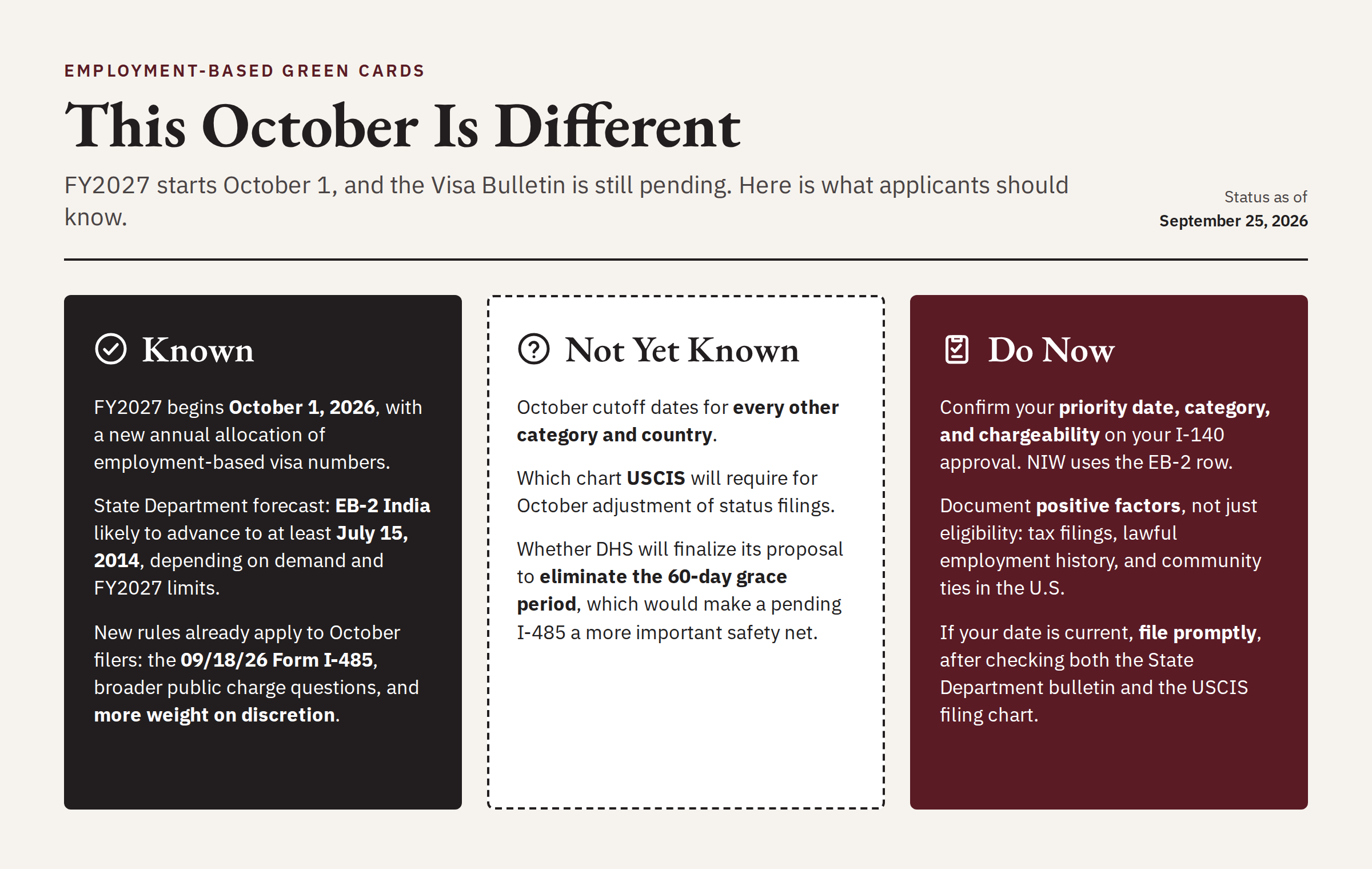 Every October 1, the federal fiscal year starts fresh, and with it a new annual allocation of employment-based immigrant visa (green card) numbers becomes available. For applicants waiting in the green card backlog, the October Visa Bulletin is generally the most anticipated release of the year. The U.S. government's fiscal year for 2027 begins Thursday, October 1, 2026, and as of this writing, the October bulletin has not yet been published.
There is a significant amount of commentary focusing on predicting where the dates will land. Regardless of what the October Visa Bulletin shows, applicants who file to adjust status will be proceeding under a set of rules that did not exist a year ago. Understanding those changes now is imperative.
First, the reset of visa numbers itself: what is known and unknown.
As mentioned above, the government's new fiscal year comes with new visa numbers. It does not, by itself, make any category current or guarantee that any cutoff date will advance. The U.S. Department of State (DOS) sets each date after reviewing demand, per-country limits, and usage. There is one official forward-looking sign. In the July 2026 Visa Bulletin, the DOS announced that the EB-2 India category was unavailable for the rest of fiscal year 2026. It stated that in October, the EB-2 India Final Action Date is likely to advance to at least the Final Action Date listed in the May 2026 bulletin, which is July 15, 2014, depending on demand and the fiscal year 2027 limits. It gave a similar conditional signal for the EB-5 India unreserved category. Beyond that, the October cutoff dates for every other category and country, and the total employment-based limit for fiscal year 2027, will not be known until the bulletin is published.
A second caveat to the release of the visa bulletin is that potential adjustment of status applicants also need to watch out for whether the U.S. Citizenship and Immigration Services (USCIS) will allow adjustment of status applications to be submitted in October based on the visa bulletin's Final Action Dates chart or its Dates for Filing chart. USCIS typically announces which chart can be used shortly after the release of the bulletin on their website here. Over the last few months, they have gone with Chart A, "Final Action Dates," for the employment-based visa categories, while under the family-based categories they have gone with Chart B, "Dates for Filing." This is a key distinction to watch out for.
What is different this year: Three (3) changes October filers will face.
- A new Form I-485 (Application to Register Permanent Residence or Adjust Status) and broader public charge questions. USCIS published a revised Form I-485, edition date 09/18/26, aligned with its new public charge rule, and it is rejecting older editions. The new public charge guidance applies to adjustment applications filed on or after September 18, 2026, so every October filer is subject to the new guidance. The revised form asks broader questions about past receipt of certain public benefits. Applicants should review their benefits history carefully before filing.
- Discretion now carries more weight. In May 2026, USCIS issued Policy Memorandum, which emphasizes that adjustment of status is a matter of discretion. It directs officers to weigh the "totality of the circumstances" and indicates that the mere absence of negative factors is not, by itself, sufficient. The statute has not changed, and eligible applicants can still adjust status inside the U.S. However, the practical effect is that an application which simply proves eligibility for the green card category may no longer be the strongest filing. It may be beneficial to affirmatively include positive factors with a green card application, such as your lawful U.S. immigration history, positive local community ties, community service, etc.
- A pending I-485 may become a more important safety net. The U.S. Department of Homeland Security (DHS) has proposed a rule that would eliminate the discretionary 60-day grace period now available to workers in E-1, E-2, E-3, H-1B, H-1B1, L-1, O-1, and TN status after their employment ends. The proposal is not final, and the 60-day grace period remains in effect today. I cover this in detail in my article from September 1, 2026, which can be found here. A pending adjustment application can provide options that nonimmigrant status alone does not. These include eligibility to apply for employment authorization and, once the application has been pending for 180 days, the ability in many cases to move to a same or similar job under the green card portability rules. For applicants whose priority dates allow them to, that is a strong reason to file promptly rather than wait.
A preparation checklist for applicants.
- Confirm the basics from your I-140 approval notice. Verify your priority date, preference category, and country of chargeability. Chargeability is generally based on country of birth, not citizenship, and cross-chargeability to a spouse's country of birth may be available in some cases (for example, if you were born in India and your spouse was born in another country, you may be able to use your spouse's country of birth if you are immigrating together and that country's date is more favorable).
- Identify your derivative family members. Confirm which family members will file with you, and flag any child approaching age 21 for a Child Status Protection Act (CSPA) review.
- Gather core documents. These typically include long form birth certificates, passports, evidence of lawful status, a current employment verification letter, and the medical examination on the current edition of Form I-693, completed by a USCIS-designated civil surgeon.
- Document positive factors and not just eligibility to file. Depending on the facts, this may include tax filings, a consistent record of lawful employment, professional contributions, and family and community ties in the U.S.
- Address your immigration history directly. Prior visa refusals, status gaps, or other issues do not necessarily prevent approval, but they should be disclosed accurately and explained.
- Check both official sources before filing. The October bulletin and the USCIS Adjustment of Status Filing Charts page.
For employers.
Employers can help sponsored employees move quickly by having employment verification letters ready, confirming that the job offer underlying each I-140 remains available, and reviewing which employees may become eligible to file once the bulletin has been released.
Key takeaway.
October 1 brings new visa numbers, and for many applicants, it may bring a long-awaited chance to file a green card application. With that, this October is not like past ones. Form I-485 has been revised, the disclosure questions are broader, discretion carries more weight, and a pending application may matter more than ever if the grace period disappears. Prepare now, act on the official October charts, once released, rather than predictions, and file a complete, well-documented case.
Our firm advises individuals and employers on employment-based green card strategies, including adjustment of status timing and preparation for the new discretionary and public charge standards.