
On October 7, 2026, the U.S. Department of Homeland Security (DHS) released the text of a proposed rule that would impose new fees on Optional Practical Training (OPT) for F-1 students. The rule is scheduled for official publication in the Federal Register on October 8, 2026.
In my September 14 article, I noted that the widely reported $100,000 figure hadn't been confirmed. Now the rule text is out. It's structured as two separate fees, paid by schools, but for a STEM graduate, the total still reaches $100,000.
What the proposal says.
- $70,000 for initial OPT. This applies the first time a school recommends a student for any type of OPT, during or after studies.
- $30,000 for each later OPT, including the 24-month STEM OPT extension. A STEM graduate using post-completion OPT and then STEM OPT would total $100,000. Adding pre-completion OPT during school brings it to $130,000.
- Schools pay. The school must pay before its Designated School Official (DSO) can recommend a student for OPT, and USCIS won't approve the work permit without payment. However, DHS acknowledges schools may pass the cost on to students or employers.
- The fee follows the recommendation, not the job. Changing employers doesn't trigger a new fee, and refunds are available only if the student never receives the work permit.
What has not changed.
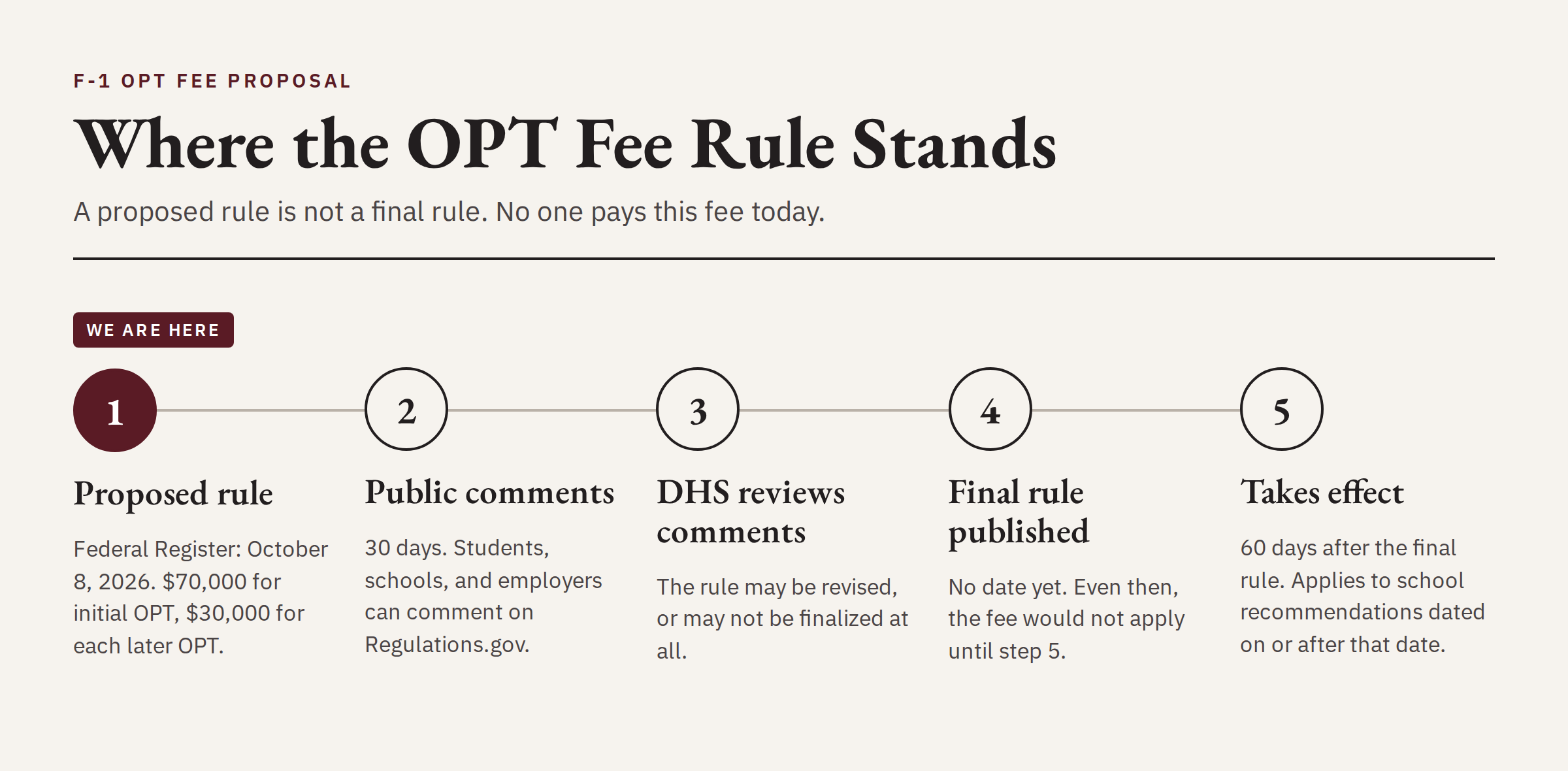 This is a proposed rule. It isn't in effect, and no one pays this fee today. If finalized, it would take effect 60 days after the final rule is published and apply only to DSO recommendations dated on or after that date. Students already on OPT or already recommended wouldn't be charged for that authorization, but a later request, such as a STEM OPT extension, would be.
DHS cites OPT fraud and the protection of U.S. workers as its reasons, and states that without the fees, it may shut down OPT entirely.
What this means for employers.
Many employers, especially startups and tech companies, rely on OPT and STEM OPT to bridge new graduates to a potential H-1B nonimmigrant visa. If this rule is finalized, that bridge could cost $100,000 per student, and schools may ask employers to share it. Employers should map when current OPT employees will need STEM extensions and watch for how universities decide to handle fees.
What this means for students.
Don't make irreversible decisions yet, since the rule may change after comments. Talk to your DSO about timing, and if you're on OPT now, plan ahead for any STEM extension that may fall after the effective date.
How to comment.
Once the rule is published on October 8, DHS will accept comments for 30 days on Regulations.gov, under Docket No. ICEB-2026-0100. Comments with specific data and real-world impact carry the most weight.
Key takeaway.
The OPT fee proposal is real, but it's not final and not in effect as of the date of this posting. At $70,000 for initial OPT and $30,000 for each later authorization, a typical STEM path would cost $100,000, with schools on the hook and the cost likely spreading to students and employers. Now is the time to plan and to weigh in.