
For employers who sponsor foreign national employees for permanent residence (a green card), the long-awaited modernization of PERM, the labor certification program, has moved from a hypothetical to a real possibility.
On 09/14/2026, the U.S. Department of Labor's (DOL) proposed rule reached the White House for review, which is generally the last procedural step before a proposed rule can be published. See my prior article, which includes an infographic explaining the federal rulemaking process at a high level. As of the date of this article, the regulatory text has not yet been made public, and nothing has changed in how PERM works. But the proposed rule's abstract, which signals revised recruitment standards, tighter scrutiny of employer layoffs, and stronger non-discrimination requirements, combined with the fact that PERM has gone largely untouched since 2004, makes this a practical moment for employers to take note. Here is where things stand now and what to do about it.
What PERM is, and why it matters to employers.
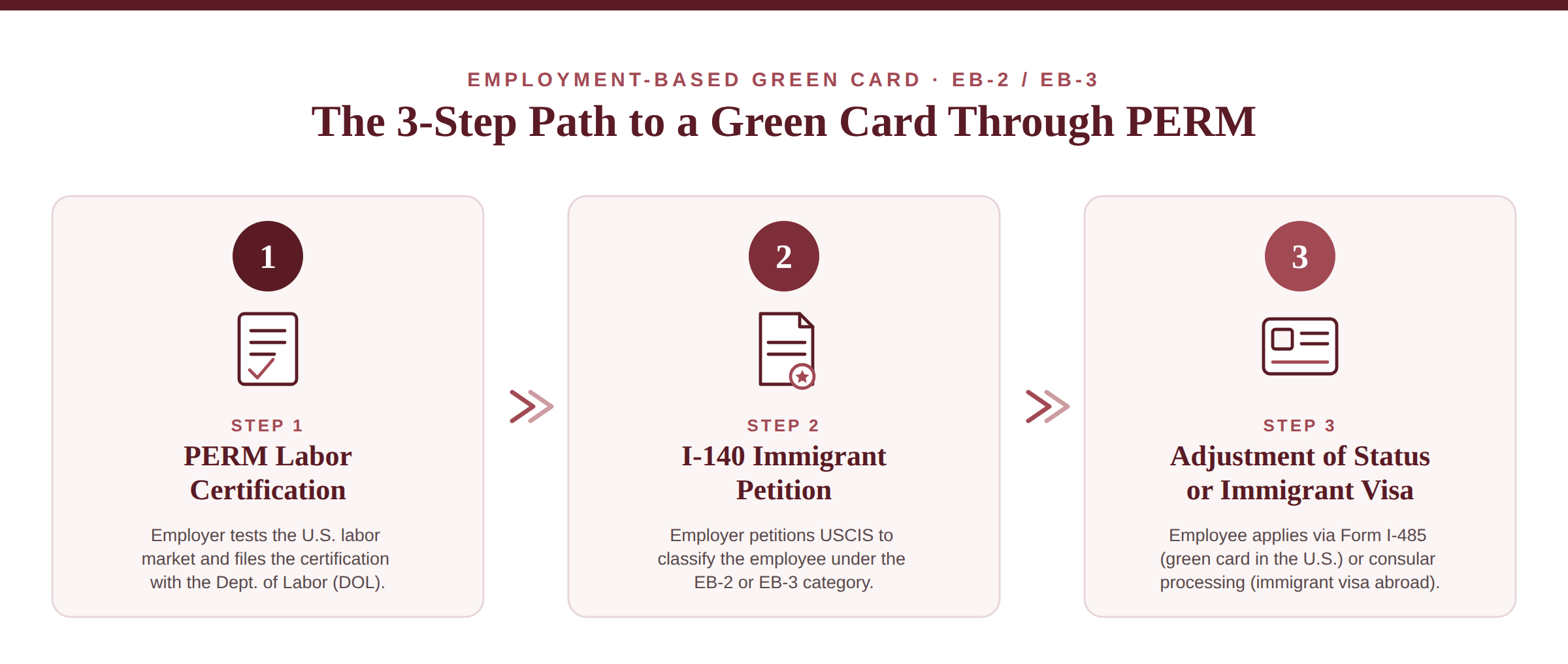
PERM, the Program Electronic Review Management process, is the labor certification step that most employment-based green cards in the EB-2 (employment-based second preference, for professionals with advanced degrees) or EB-3 (employment-based third preference, for professionals, skilled workers, and unskilled workers) must go through when an employer sponsors an employee for lawful permanent resident status (a green card). In broad terms, an employer that wants to sponsor a foreign national under these categories for a green card must first obtain a certified labor certification (Form ETA-9089) from the DOL by testing the U.S. labor market for the position being offered and attesting that there are not sufficient able, willing, qualified, and available U.S. workers for the role, and that hiring the foreign worker will not adversely affect the wages and working conditions of similarly employed U.S. workers. That process runs through a prevailing wage determination and a defined set of "recruitment" steps, all supported by documentation the employer must retain. Only after the labor certification is approved can the employer file the I-140 immigrant petition with U.S. Citizenship and Immigration Services (USCIS), and ultimately the adjustment of status or green card application. Because PERM sits at the front of that sequence, changes to it can impact every application that follows.
 Where the proposal stands today.
The action sits on the DOL's regulatory agenda as a "proposed rule" titled "Modernizing the Labor Market Test and Improving Protections for U.S. Workers in the PERM Immigrant Visa Program." It reached the White House Office of Information and Regulatory Affairs (OIRA) for review on 09/14/2026. OIRA review is generally the final checkpoint before an agency can publish a proposed rule in the Federal Register, which means this is close, but not quite final. As of now, the regulatory text is not public, no comment period has opened, and no requirement has changed. Employers continue to operate under the current PERM regulations in full.
Why the known process may be preferable to the unknown one.
The current PERM process is not quick or easy. It involves a prevailing wage determination that can take months, a prescribed sequence of "recruitment," or labor market test efforts, careful review of U.S. applicants by the sponsoring employer, and meticulous documentation, followed by PERM application (Form ETA-9089) processing times at the DOL that are long (currently over a year) and, at times, unpredictable, with the possibility of an audit. That said, the current DOL process is known. Employers and their immigration counsel understand the current steps, the evidence required, and the timelines, and can plan around them today.
The proposal signals a different and likely heavier framework, essentially a shift away from the 2004 rules, which largely do not reflect the "real world recruitment" employers undertake when looking for talent. The DOL states in the abstract for the proposal that it wants to improve the minimum standards for recruiting U.S. workers, strengthen safeguards for U.S. workers affected by layoffs, and enhance employer compliance with nondiscrimination and record-keeping requirements. All of this points toward more employer obligations and closer scrutiny rather than less, although it may fall more in line with what employers actually do when looking for candidates. With that, the current process, although a bit antiquated and clunky, may be the more manageable one compared with the newly proposed process. For an employer with foreseeable sponsorship needs, there could be real value in making progress under today's rules, since they are known, rather than waiting for a standard that has not yet been publicly released.
What could change, understanding that the text is not public.
As the text of the proposed rule is not yet available, the following is taken from the DOL's stated aims, not from any published rule. The recruitment and labor market test is expected to be modernized, with more emphasis on digital and online recruitment channels that reflect how hiring actually happens now, and correspondingly clearer documentation of where and when positions were advertised and how the recruitment reached qualified U.S. workers. Standards for evaluating U.S. applicants may be tightened, with greater documentation of the applicant review process and clearer, job-related explanations for why U.S. applicants were not selected. Employers with recent layoffs or workforce reductions in related occupations may face heightened scrutiny, consistent with the stated goal of protecting U.S. workers affected by layoffs. Record-keeping and compliance obligations are likely to expand, potentially covering recruitment advertisements and posting dates, applicant resumes and screening notes, interview records, the reasons applicants were rejected, changes to the position or its minimum requirements, and layoffs or reductions affecting similar roles. Wage-related provisions could be adjusted to align with current labor market conditions. Again, none of this is confirmed, and the specifics, along with any effective date and any transition or grandfathering provisions, will come from the actual rule.
Who is affected.
The DOL's proposal matters to any employer that sponsors, or expects to sponsor, employees for permanent residence in the EB-2 or EB-3 categories, and to the HR, talent acquisition, and mobility teams that run "recruitment" and keep the records. Foreign national employees who are being sponsored by their employers and going through the PERM process should also understand how the process works, along with the wait times.
A separate proposal to speed up PERM processing time.
While the proposed PERM modernization rule could make PERM more demanding, a separate proposal in Congress tackles a different problem, the PERM backlog and significant wait times. In August 2026, a bipartisan bill, the PERM Backlog Reduction Act of 2026 (H.R. 10051), would direct the DOL to create an optional premium processing program for PERM labor certifications, similar to the premium processing USCIS already offers for certain petitions. Under the bill, an employer could pay a fee, set at $1,200 and adjusted for inflation in later years, to have the DOL issue a decision on the labor certification (Form ETA-9089) within 30 calendar days.
As a note, this is currently a bill, not a rule, and not a law, and whether it becomes law is unknown at this time. It is simply something to keep an eye on. This proposed legislation is also separate from the DOL's modernization rule described above.
Key takeaway.
Employers who are considering sponsoring employees, or who are currently working through the PERM process, should engage in deliberate preparation and should not be alarmed or rushed into defective filings or labor market test efforts. The current PERM rules remain the law, since nothing has changed yet with this proposal. It is best to use this window to get ahead of what may be coming: audit your pipeline for documentation gaps, tighten and preserve your "recruitment" records, and coordinate immigration and HR before "recruitment" begins. This may also be a good time to look ahead and map out your foreseeable sponsorship needs, keeping in mind maximum visa periods (for example, generally six years for H-1B visa holders), and to weigh timing and strategy with immigration counsel, bearing in mind that a future rule's reach to cases already pending is unknown. Watch for the proposed rule so you can weigh in once the comment period opens.
If your organization depends on PERM to retain and advance key talent, the practical questions are whether your current cases would withstand closer scrutiny, whether your foreseeable filings should move now rather than wait, and how to strengthen recruitment and record-keeping regardless of what the final rule says.