
In March 2026 the U.S. Department of Labor (DOL) proposed raising all four prevailing wage levels used in the H-1B, H-1B1 (Chile and Singapore), E-3 (Australia), and PERM programs. Because those levels set the minimum an employer must pay a sponsored worker, raising them raises the cost of sponsorship at every experience level. The rule is not final, the comment period has closed, and a similar effort was set aside in court in 2020. Here is what it would change, what it could cost, and how to plan.
What a prevailing wage is.
For most employment-based cases, the employer must pay at least the prevailing wage for the job in the area of intended employment. For H-1B, H-1B1, and E-3 cases the obligation is the higher of the prevailing wage or the employer's actual wage for similarly employed workers. The DOL sets the prevailing wage using four levels tied to experience and responsibility, from Level I for entry-level roles to Level IV for fully competent ones. Each level corresponds to a point in the wage distribution for that occupation, drawn from federal survey data. These levels drive the wage obligation in the Labor Condition Application (LCA) required for H-1B, H-1B1, and E-3 filings, and in a PERM labor certification, so where they sit determines what an employer pays.
What would change.
Each level would move well up the wage distribution:
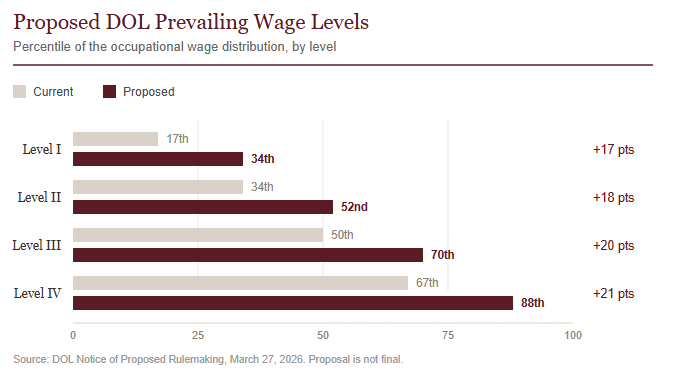
The entry-level floor would land roughly where the mid-level floor sits today. Because these are percentile shifts rather than flat dollar figures, the exact effect varies by occupation and location, but the direction is uniformly upward.
The DOL's reasoning.
Under current rules, the DOL argues, a sponsored worker can sometimes be paid less than a U.S. worker in the same job. When that is possible, the lower wage itself becomes a reason to sponsor, and the programs start to function as a source of lower-cost labor rather than a way to fill genuine gaps. Raising the required wage is meant to remove that incentive so employers select based on fit rather than cost.
What it would cost sponsoring employers.
The DOL's own analysis projects an average of about $7 billion a year in additional wages, starting near $1.5 billion in year one and exceeding $9 billion annually once fully phased in. That works out to roughly $14,000 to $14,600 more per affected position at steady state.
The impact is not evenly spread. Entry-level positions see the largest proportional jump, because Level I moves the most in percentile terms. Smaller employers and firms in wage-sensitive fields absorb the most, because they have the least room to accommodate an increase of that size. At the senior end, a wage bump folds into an already large budget. At the junior end, it can exceed the entire margin the role was approved on. That is where positions get cut rather than repriced, and a job that is never created protects no one.
Which programs are affected.
The proposal reaches the wage levels used in H-1B, H-1B1 (Chile and Singapore), E-3 (Australia), and the PERM labor certification process underlying most EB-2 and EB-3 pathways. It touches both temporary and permanent tracks, which makes it a workforce planning issue rather than a single filing season issue.
Where it stands.
The rule was published in late March 2026 with a 60-day comment period that closed in the spring. The DOL is now reviewing comments and deciding whether to finalize as written, revise, or withdraw. Until a final rule takes effect, nothing changes and current wage levels continue to apply.
Pending cases would not be grandfathered. As proposed, a prevailing wage determination (PWD) request that is pending on the effective date, or filed on or after it, would be subject to the new levels, as would certain LCAs filed on or after that date. PWDs and LCAs already issued or certified would not be affected.
The 2020 precedent.
The DOL tried this in 2020, at percentiles even higher than those now proposed. Courts set that rule aside largely on procedural grounds, because the agency issued it as an emergency rule and skipped the ordinary rulemaking process without adequate justification. A follow-on rule issued in January 2021 was delayed, challenged, and ultimately never took effect.
This proposal covers much of the same ground, but through the ordinary rulemaking process. The rule will most likely be challenged once it has been finalized, but employers should not rely on that.
Private wage surveys remain available as an alternative.
The DOL's survey data is the default, but it is not the only option. An employer may support the required wage with a qualifying private wage survey, and the proposed rule keeps that door open. The DOL considered eliminating private surveys and decided against it, reasoning that they can better reflect market wages in specialized labor markets where federal data is a poor fit. In some occupations a private survey may produce a lower wage than the DOL's proposed levels.
How to plan:
- Understand the exposure now. Run the proposed levels against your most frequently sponsored roles, especially entry-level and high-volume positions, so you know the cost before a final rule lands.
- Watch PERM timing. For pending and upcoming PERM cases, the timing of the PWD request matters. Build the new wage assumptions into your recruitment and budgeting.
- Consider private survey options. Determine whether a qualifying alternative survey exists for the roles you sponsor most, and submit it with the prevailing wage request so the National Prevailing Wage Center can consider it.
- Look at upcoming filings. For H-1B, H-1B1, and E-3, consider how a higher prevailing wage would affect upcoming petitions such as extensions, amendments, and change of employer petitions.