
UPDATE · AUGUST 27, 2026
The decision striking down the freeze still stands, but it is not yet clear how the State Department is putting it into practice. In the meantime, it has been reported that scheduled immigrant visa interviews were being cancelled at consulates worldwide so that officers could be retrained on the public charge rules. The State Department has also not yet updated the public facing Foreign Affairs Manual (FAM) on public charge. The bottom line has not changed: the freeze is no longer in effect, but processing may not return to normal right away. If your case was affected, confirm where it stands with the National Visa Center or your consulate before making any big plans.
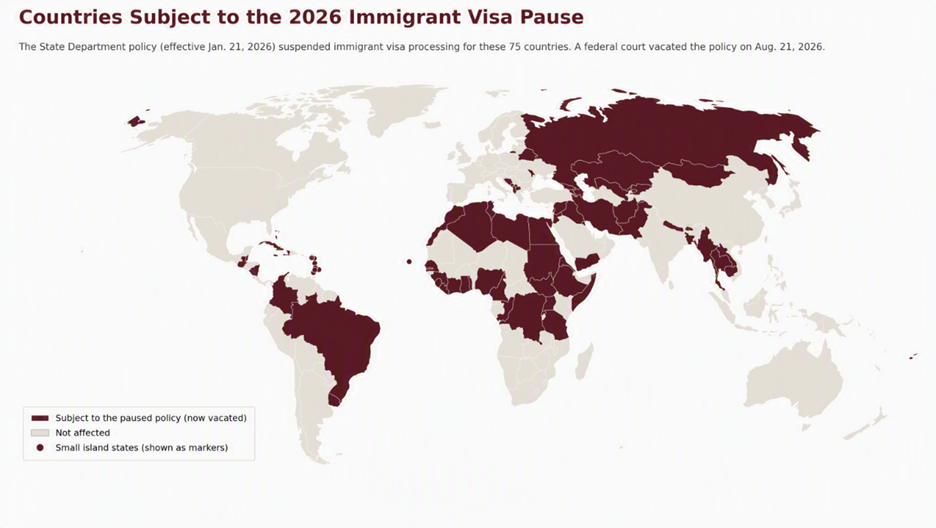
A federal court has struck down the U.S. Department of State policy that had frozen green card (immigrant visa) processing for people from 75 countries. The decision came on August 21, 2026, and the short version is this: the freeze is no longer in effect at this time.
Here is what happened, in plain terms, and what it may mean for you or your family.
The freeze, in a nutshell.
Back in January 2026, the U.S. State Department stopped issuing immigrant visas to people from 75 countries. The reason it gave was a concern that people from those countries were more likely to need public benefits. The freeze was applied across the board, so applicants were turned away based on their country alone, even if they personally qualified in every other way.
A court has now said the government did not have the authority to do that, because the law does not allow visas to be denied to an entire nationality as a group. As a result, the policy has been thrown out.
This affected immigrant visas, which is the path to a green card from outside of the U.S.. It did not touch temporary visas like visitor, student, or work visas. It is separate from the various travel bans and country restrictions, so this ruling does not undo those.
Which countries were affected.
The immigrant visa pause applied to nationals from the following 75 countries:
|
Afghanistan |
Albania |
Algeria |
|
Antigua and Barbuda |
Armenia |
Azerbaijan |
|
Bahamas |
Bangladesh |
Barbados |
|
Belarus |
Belize |
Bhutan |
|
Bosnia and Herzegovina |
Brazil |
Burma (Myanmar) |
|
Cambodia |
Cameroon |
Cape Verde |
|
Colombia |
Côte d'Ivoire |
Cuba |
|
Democratic Republic of the Congo |
Dominica |
Egypt |
|
Eritrea |
Ethiopia |
Fiji |
|
Gambia |
Georgia |
Ghana |
|
Grenada |
Guatemala |
Guinea |
|
Haiti |
Iran |
Iraq |
|
Jamaica |
Jordan |
Kazakhstan |
|
Kosovo |
Kuwait |
Kyrgyzstan |
|
Laos |
Lebanon |
Liberia |
|
Libya |
Moldova |
Mongolia |
|
Montenegro |
Morocco |
Nepal |
|
Nicaragua |
Nigeria |
North Macedonia |
|
Pakistan |
Republic of the Congo |
Russia |
|
Rwanda |
Saint Kitts and Nevis |
Saint Lucia |
|
Saint Vincent and the Grenadines |
Senegal |
Sierra Leone |
|
Somalia |
South Sudan |
Sudan |
|
Syria |
Tanzania |
Thailand |
|
Togo |
Tunisia |
Uganda |
|
Uruguay |
Uzbekistan |
Yemen |
What this means if your case was paused under the immigrant visa ban.
If your immigrant visa processing was put on hold only because of your country of nationality, that reason is now gone, and cases that were refused for that reason alone are supposed to be looked at again. That is welcoming news for a lot of families who were stuck through no fault of their own.
Some important limits on what this ruling means:
- This does not approve anyone automatically. You still have to meet all the normal requirements and pass the usual screening. What changed is that your country can no longer be the reason for a "no."
- If your case was denied for some other reason too, not just the freeze, this ruling by itself does not fix that other reason.
- The government may still appeal, and consulates will take time to work back through the cases that were held. So expect this to move gradually, not overnight.
What to do next.
If you or a relative has a green card case from one of these countries, the smart move is to check where your case actually stands with the National Visa Center (NVC) or your consulate before making any big decisions, such as booking travel, quitting a job, or giving up a lease abroad.